




Overcoming Impunity in Post-Transition Disappearances

Addressing the Persistence of Disappearances Beyond Dictatorships

OID works with academic institutions and grassroots groups in Mexico and Brazil to spotlight enforced disappearances that continue even after democratic transitions. By analyzing patterns of perpetration and impunity, the project supports victims’ demands for truth, justice, and structural change in post-authoritarian societies.
Unmasking the Project

A research initiative confronting impunity and advancing justice for victims of disappearance in Mexico.

The Overcoming Impunity in Post-Transition Disappearances project established the Observatory on Disappearance and Impunity in Mexico (ODIM)—a robust, academic-based initiative dedicated to examining the multifaceted phenomenon of disappearance across Mexico in the post-transition period. It seeks to confront impunity by illuminating patterns, causes, and consequences of disappearances and to champion truth, justice, and reparation for victims and their communities. ODIM operates through a collaborative network of institutions and research teams across Mexico and internationally, delivering informed, impactful insights into this ongoing crisis.
Our Approach

Five lines of action: information, justice, theory, data, and public impact.

ODIM advances its mission through five key operational lines:
documento analisis

Generation and analysis of information

We systematically collect and analyze data regarding disappearance events across Mexico to support the pursuit of truth, justice, and reparation for both victims and Mexican society.
justice

Justice and search process analysis

We assess levels of access to justice for victims and track progress in identifying and locating disappeared individuals.
conceptual

Conceptual framework development

We craft theoretical tools tailored to current manifestations of disappearance, fostering rigorous academic and conceptual debate.
compilation

Compilation of diverse sources

We curate a comprehensive collection of official and non-official data sources—legal documents, jurisprudence, government and NGO reports, media coverage, and databases—to support multifaceted research.
speach

Public dissemination of results

We actively share findings through publications, academic events, digital platforms, and outreach to stakeholders to maximize impact.

Publications

Key Publications and Research Outputs

Overcoming Impunity in Post-Transition Dissapearances
Nombrarlas para encontrarlas
The study examines women’s disappearances in central Mexico, linking gender, state, and criminal violence, and calls for better coordination and data sharing to strengthen search and justice efforts.
Overcoming Impunity in Post-Transition Dissapearances
Report on Information Policies Regarding State Responses to the Disappearance of Persons
The report reveals inconsistent, opaque state data on disappearances in Mexico, showing failures in justice, transparency, and accountability, and urging stronger public information policies to combat impunity and support victims’ rights.
Overcoming Impunity in Post-Transition Dissapearances
Report on Criminal Sentences in Cases of Enforced Disappearance at the Federal and State Levels
The report reviews 28 rulings on enforced disappearance in Mexico, revealing limited judicial action, weak investigations, and the need to strengthen courts’ roles in ensuring truth, justice, and victims’ rights.
Overcoming Impunity in Post-Transition Dissapearances
Report on Specialized Prosecutor’s Offices
The report examines Mexico’s specialized prosecutor’s offices on disappearances, highlighting systemic impunity, limited progress, and emerging collaboration between families, collectives, and authorities to strengthen justice.
Overcoming Impunity in Post-Transition Dissapearances
Report on State Search Commissions
The report reviews Mexico’s State Search Commissions, created by the 2017 law on disappearances, highlighting progress and challenges in coordination, resources, and trust as they work to improve searches and access to truth and justice.
Overcoming Impunity in Post-Transition Dissapearances
Comparative Report on Disappearance Events: “Nuevo León, Coahuila, and Tamaulipas (Northeast Region)”
Mexico faces a major human rights crisis of widespread disappearances. The Observatory on Disappearance and Impunity studies this issue locally to support truth, justice, and public policy efforts nationwide.
Mapping Our Work

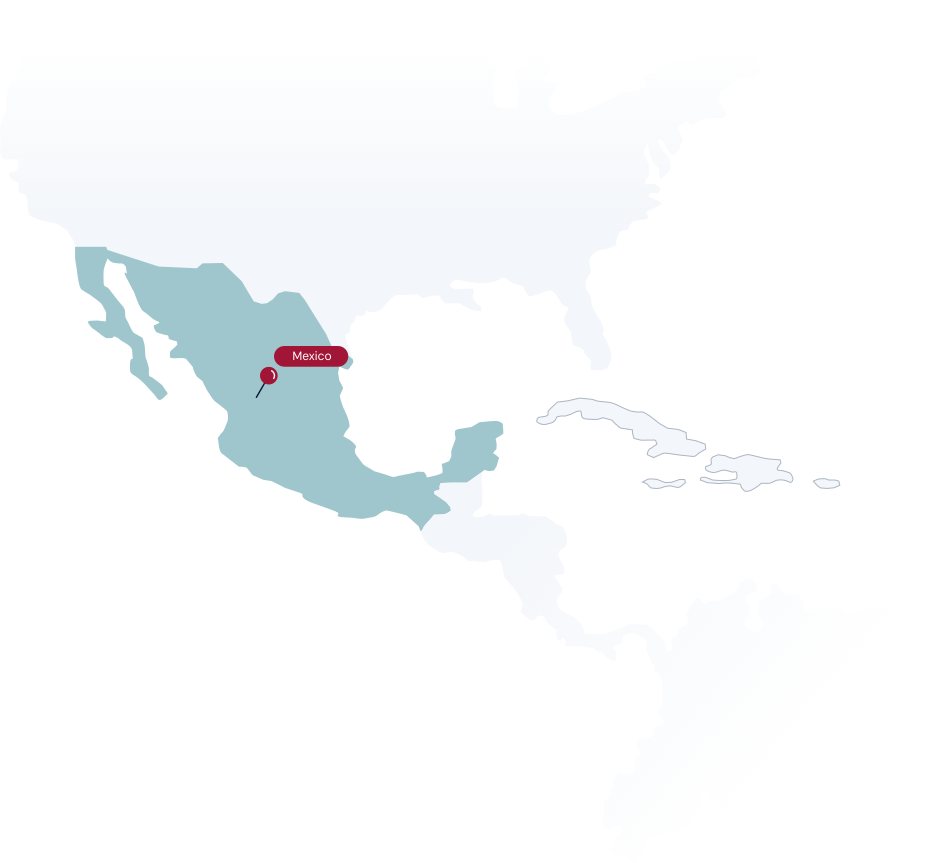
International collaboration with regional focus on Mexico’s most affected states.

ODIM is rooted in an international and interinstitutional collaboration. It is anchored at the Instituto de Investigaciones Jurídicas of UNAM and partners with FLACSO-México, the University of Minnesota, and the University of Oxford.

Research and fieldwork are concentrated across various Mexican regions—particularly in zones with some of the highest incidence of disappearances, such as Nuevo León, Coahuila, Tamaulipas, and the Mexico City metropolitan area. These targeted regional studies enable nuanced understanding of local dynamics and institutional responses.

Our Network of Collaboration

Led by academic institutions and strengthened by grassroots partnerships.

ODIM thrives through a diverse and multidisciplinary network:
UNAM

UNAM’s Instituto de Investigaciones Jurídicas

A leading academic center in Mexico that provides rigorous legal and social research, anchoring the project with its expertise in justice and human rights.
Flacso

FLACSO-México

A regional hub for social sciences in Latin America that strengthens the project through its interdisciplinary approach to democracy, law, and social policy.
Minnesota

University of Minnesota

A U.S.-based institution that contributes an international human rights perspective, fostering comparative analysis and cross-border collaboration.
Our team

Meet the Team Behind the Work for Justice

Different researchers, practitioners, and advocates from across the globe have contributed to the research projects, united by a shared commitment to human rights and accountability. With expertise spanning law, sociology, political science, and community engagement, we work collaboratively to support victims, produce impactful research, and drive systemic change.

Professor Leigh Payne

Professor of Sociology at the Latin American Centre and a member of St Antony’s College Governing Body. Her research focuses on building human rights cultures in the Americas by addressing past abuses and ongoing violations, with an emphasis on victims’ rights to truth, justice, and remedy. Her work explores transitional justice, justice from below, and contentious coexistence. She teaches Latin American sociology and human rights, and supervises graduate research in related areas, welcoming applications in these fields.

Barbara Frey

Director Emeritus of the Human Rights Program in the College of Liberal Arts at the University of Minnesota. Frey has been teaching international human rights at the University of Minnesota in both the Law School and the Institute for Global Studies since 1989. She speaks and publishes regularly on human rights topics, and has served in various positions related to human rights, in non-governmental and inter-governmental organizations as well as academic institutions.

Karina Ansolabehere

Researcher at the Institute for Legal Research (IIJ) at UNAM. My areas of interest include legal policy, human rights, sociology of law, and political theory. Concerned with the role of legal institutions in protecting and defending the population in contexts of violence, I am currently developing two lines of research that combine these areas of interest: justice systems in response to serious human rights violations, and the socio-legal dynamics of violence and serious human rights violations.