

Publications


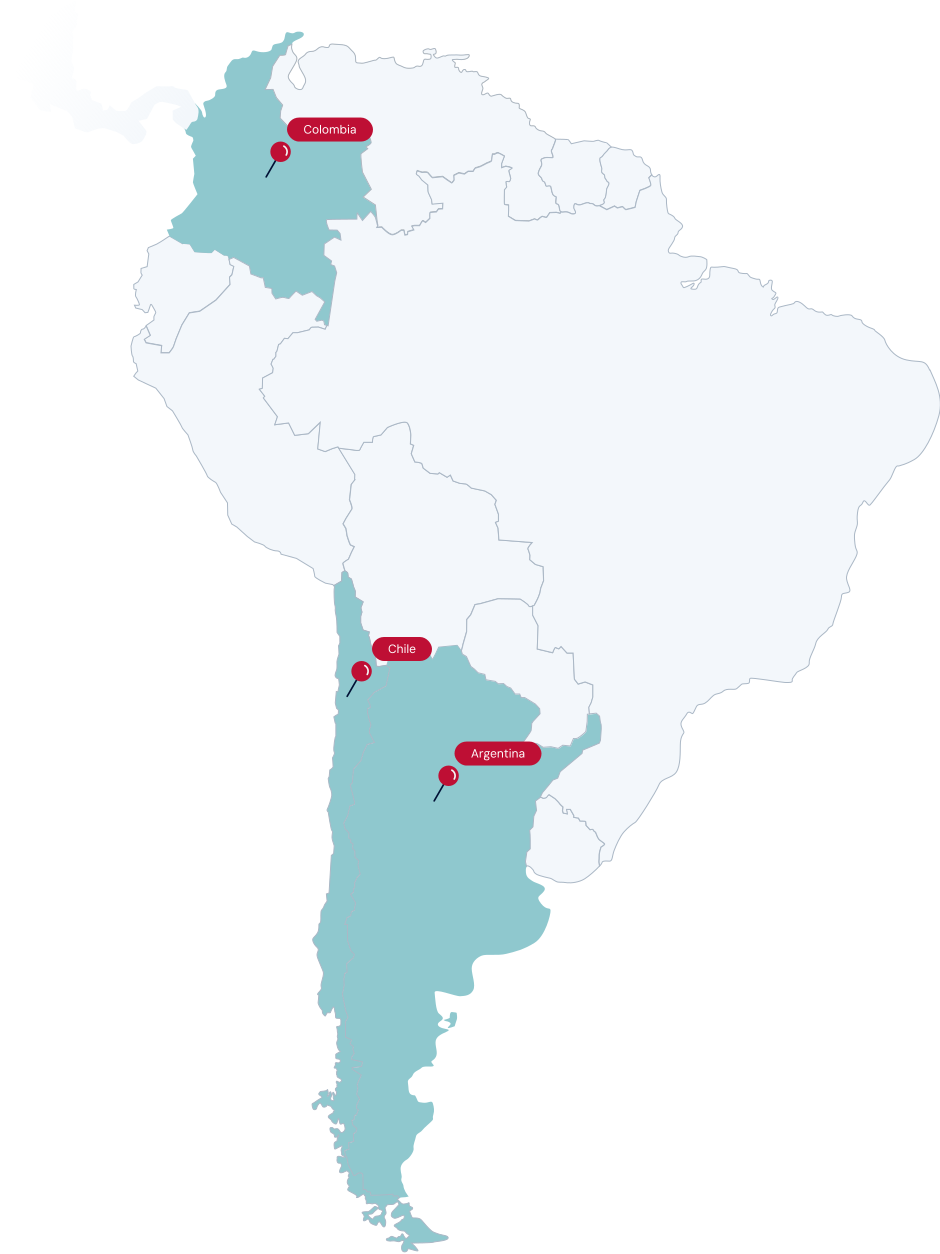
While the right-against-rights backlash is global, our core research focuses on Latin America—a region where recent rights gains have been both profound and precarious. Countries across the continent have seen sharp polarization and conflict linked to anti-rights mobilizations. By focusing on Latin America, we gain insights into how these movements evolve in fragile democracies and what strategies can help sustain inclusive political orders. These findings are applicable to other regions facing similar challenges, making our work both regionally grounded and globally relevant. The project explores mobilization by the right against rights within countries and their transnational linkages.
















Jackeline Alba Udave, Universidad Nacional Autónoma de México. LinkedIn
Ingrid Melissa Amaya Bustillo, El Colegio de México. LinkedIn
Juan Carlos Bautista Murillo, Universidad Nacional de Tucumán. LinkedIn
Daniela Correa Pinto, Universidad del Rosario. LinkedIn
Matías González Arias, Pontificia Universidad Católica de Chile. LinkedIn
Elsie Haldane, University of Oxford. LinkedIn
Juliana Jaramillo, Universidad de los Andes. LinkedIn
Ignacia Saavedra Abarca, Pontificia Universidad Católica de Chile. LinkedIn
Ila Zelmanovitz Axelrod, University of Oxford. LinkedIn
We use only essential cookies that keep this site working properly. We don’t collect or share personal data. You can accept or deny cookies at any time.
Full list of publications by Leigh A. Payne:
Additional Team Publications:
List of grants secured by different team members building on the Right-against-Rights project:
Our original proposal identified key academic and impact objectives. Below we discuss those original objectives and the lessons learnt from pursuing them, including unintended consequences or outcomes of the research.
Academic contribution to the analysis of right-wing mobilization and global (dis)order.
By developing a comparative cross-regional analysis of right-wing mobilizations, we aimed to, and succeeded in, developing scholarship on Latin America. We developed the first database of right-wing anti-rights groups for the region. Prior to our work, scholarship was nearly exclusively focused on the right in Europe and North America. We found that the frameworks developed for those regions do not travel well to Latin America. By identifying and developing categories of anti-rights groups (countermovements, uncivil movements, and radical neoliberal mobilizations), we achieved our objective of generating a more effective framework for cross-national and cross-regional comparative analysis of mobilizations on the right that is broadly applicable. Our work has begun to influence scholarship on the right.
Using the findings from the database, we were able to systematically analyze who mobilizes against rights, when, why, where, how, and with what impact. We conducted our analysis across Latin America and developed a framework that can be applied to other regions of the world. We built knowledge frontiers through a network of scholars, including early career scholars and senior scholars, from across the region and from a range of disciplines. Through this network, we coordinated events aimed at enhancing the study of right-wing mobilization as a threat to social order in fragile democracies. We built a global network of scholars working on threats from the right to historically marginalized communities.
Some of the surprising outcomes from our research include the following:
– The vast number of groups mobilized in the region.
– The cross-border networks those groups have formed within the region.
– The transnational networks developed outside the region between the Global North and the Global South.
– The knowledge that some Latin American right-wing groups (such as Con Mis Hijos No Te Metas) have organized within the Global South but have impact in the Global North, altering our perspective on the location and scope of right against rights mobilization.
– The links between anti-rights groups and religious organizations and new alliances among previously antagonistic evangelical protestant and Catholic groups in efforts to rollback gender rights.
– The number of anti-rights groups focused on gender and the rollback of women’s rights in Latin America (around 70% of actors target women’s rights, and 75% target women’s rights or LGBTIQ+ rights combined).
Impact contribution to reduce global (dis)order arising from threats to democratic citizenship rights of historically excluded peoples:
We engaged in information and visibility politics (database, monitoring & tracking system, news and policy reports) to identify efforts to roll back rights gains and aspirations for the LGBT+, BIPOC, and economically-disadvantaged and environmentally-vulnerable communities, women, and victim-survivors demanding accountability for human rights violations across the Latin American region.
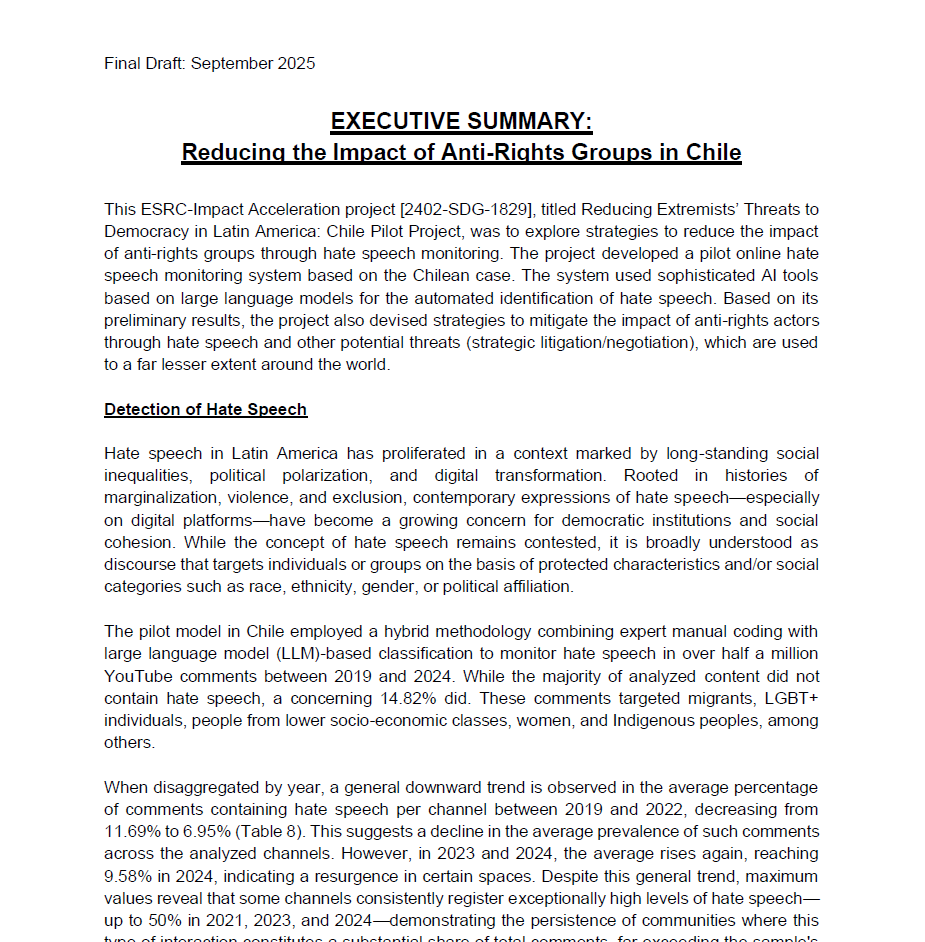
We created spaces to develop and promote policies to address anti-democratic activities by the right against rights, including violence and discrimination against rights-seekers. We disseminated the policy and practice developed for Latin America to other world regions. For example, we shared our findings on Chilean hate speech monitoring with organizations in the United States and the United Kingdom.
List of impact activities in chronological order: